
Company post
Therapist Confidentiality: What Your Therapist Can Share, by State
· Couch Commons
What stays private in therapy, the exceptions every state has, and how duty-to-warn laws differ by state, with the law for each.
Therapist confidentiality means what you say in therapy stays between you and your therapist. That is the rule. There are a few exceptions, and they are written into law. Some are the same in every state. One of them, the "duty to warn," is different depending on where you live.
This page explains the exceptions in plain language, then lists what each state's law says, with the statute so you can read it yourself.
This is general information, not legal advice. The surest way to know the rules for your therapist is to ask them. Most therapists explain the limits of confidentiality in the first session and in the consent form you sign.
What stays private
Almost everything. Your feelings, your history, your relationships, things you are ashamed of, past mistakes, drug or alcohol use, and thoughts you have never told anyone. Your therapist cannot share these with your family, your employer, or your friends without your written permission.
Confidentiality is not only a professional habit. It is required by state licensing laws and by the ethics codes therapists must follow, such as the NASW Code of Ethics for social workers.
The exceptions
These are the situations where a therapist may, or must, share information. Each one is narrow. In each case, the therapist shares only what is needed.
1. Abuse or neglect of a child. Therapists are mandated reporters in every state. If they have reason to believe a child is being abused or neglected, they must report it to child protective services.
2. Abuse or neglect of an older or dependent adult. Most states also require a report when an older adult or an adult who depends on others for care is being abused, neglected, or exploited.
3. Serious, immediate risk to your own life. If you are at risk of ending your life soon, your therapist may act to keep you safe. That usually starts with a safety plan made together. It can include contacting emergency services. Having thoughts of suicide, on its own, does not mean you will be hospitalized. Therapists talk with people about these thoughts every day.
4. A serious threat to another person (the "duty to warn"). If you make a serious threat to harm a specific person, your therapist may have to warn that person or the police, or take other steps to protect them. This is the exception that differs most by state. See the list below.
5. A court order. A judge can order a therapist to release records or testify. A subpoena from a lawyer is not the same as a court order. Therapists usually push back on subpoenas and share as little as the law allows.
If you are in crisis, call or text 988 (US).
Where the duty to warn came from
In 1969, a university student named Prosenjit Poddar killed Tatiana Tarasoff. He had told his therapist he planned to kill her. In 1976, the California Supreme Court ruled in Tarasoff v. Regents of the University of California that therapists have a duty to protect people their clients seriously threaten. Most states then passed their own laws. They did not all choose the same rule. (Psychiatric News, APA)
States fall into three groups:
- Must act: the therapist must act when there is a serious threat against someone who can be identified.
- May act: the therapist may act, but is not required to.
- No duty: the law does not create a duty to warn.
Some states have different rules for different kinds of therapists. A psychologist and a social worker in the same state can be under different statutes.
Duty to warn, by state
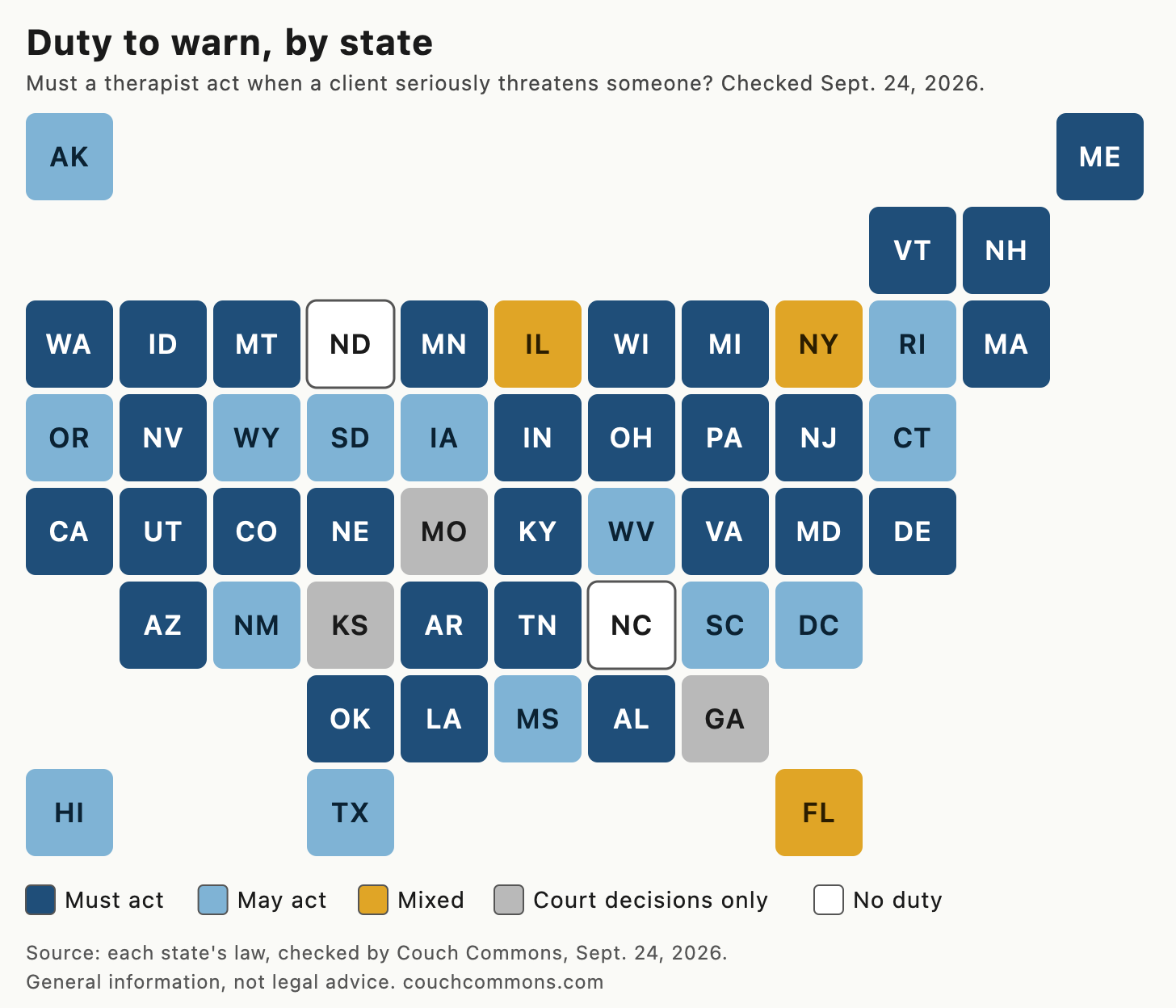
Checked against each state's current law on September 24, 2026, starting from the National Conference of State Legislatures summary (updated March 16, 2022). "Must act" means the therapist must warn or protect. "May act" means the law allows it but does not require it. Some states have different rules for different professions. Laws change. Check the law or ask your therapist for the current rule.
- Alabama: Must act (counselors and marriage and family therapists). Law: Ala. Code §§ 34-8A-24, 34-17A-23
- Alaska: May act (counselors). Law: Alaska Stat. § 08.29.200
- Arizona: Must act (behavioral health professionals). Law: Ariz. Rev. Stat. § 32-3283(C)
- Arkansas: Must act (duty to protect). Law: Ark. Code § 20-45-202
- California: Must act (duty to protect). Law: Cal. Civ. Code § 43.92
- Colorado: Must act. Law: Colo. Rev. Stat. § 13-21-117
- Connecticut: May act. Law: Conn. Gen. Stat. §§ 52-146c, 52-146f
- Delaware: Must act (duty to protect). Law: Del. Code tit. 16 § 5402
- District of Columbia: May act. Law: D.C. Code § 7-1203.03
- Florida: Mixed: may warn the person; must tell police. Law: Fla. Stat. §§ 456.059, 490.0147, 491.0147
- Georgia: Duty to protect from court decisions only. Law: Bradley Center v. Wessner (1982)
- Hawaii: May act (psychologists and clinical social workers). Law: Haw. Rev. Stat. § 626-1, Rule 504.1; § 467E-15
- Idaho: Must act. Law: Idaho Code § 6-1902
- Illinois: Mixed: must act (physicians, psychologists); may act (other therapists). Law: 405 ILCS 5/6-103; 740 ILCS 110/11
- Indiana: Must act. Law: Ind. Code §§ 34-30-16-1, -2
- Iowa: May act (may tell police). Law: Iowa Code § 228.7A
- Kansas: Court decisions only. Law: Boulanger v. Pol (1995)
- Kentucky: Must act. Law: Ky. Rev. Stat. § 202A.400
- Louisiana: Must act. Law: La. Rev. Stat. § 9:2800.2
- Maine: Must act (since 2019). Law: 32 M.R.S. §§ 2600-D, 3300-G, 3820, 6207-C, 7006, 13866
- Maryland: Must act. Law: Md. Code, Cts. & Jud. Proc. § 5-609
- Massachusetts: Must act. Law: Mass. Gen. Laws ch. 123 § 36B
- Michigan: Must act. Law: Mich. Comp. Laws § 330.1946
- Minnesota: Must act. Law: Minn. Stat. § 148.975
- Mississippi: May act. Law: Miss. Code § 41-21-97
- Missouri: Court decisions only (the law often cited was repealed in 2023). Law: Bradley v. Ray (1995)
- Montana: Must act. Law: Mont. Code § 27-1-1102
- Nebraska: Must act (psychologists). Law: Neb. Rev. Stat. § 38-3132
- Nevada: Must act (since 2015). Law: Nev. Rev. Stat. § 629.550
- New Hampshire: Must act. Law: N.H. Rev. Stat. § 329-B:29
- New Jersey: Must act. Law: N.J. Stat. § 2A:62A-16
- New Mexico: May act. Law: N.M. Stat. § 43-1-19
- New York: Mixed: must report to the county (firearms law); may warn the person. Law: N.Y. Mental Hyg. Law §§ 9.46, 33.13
- North Carolina: No duty. Law: Gregory v. Kilbride (2002)
- North Dakota: No duty found.
- Ohio: Must act (duty to protect). Law: Ohio Rev. Code § 2305.51
- Oklahoma: Must act (psychologists). Law: Okla. Stat. tit. 59 § 1376
- Oregon: May act. Law: Or. Rev. Stat. § 179.505
- Pennsylvania: Must act, from court decisions. Law: Emerich v. Philadelphia Center for Human Development (1998)
- Rhode Island: May act. Law: R.I. Gen. Laws § 5-37.3-4
- South Carolina: May act. Law: S.C. Code § 44-22-90
- South Dakota: May act. Law: S.D. Codified Laws § 27A-12-29
- Tennessee: Must act, and must report the threat (updated 2024). Law: Tenn. Code § 33-3-206
- Texas: May act. Law: Tex. Health & Safety Code § 611.004
- Utah: Must act. Law: Utah Code § 78B-3-502
- Vermont: Must act. Law: Peck v. Counseling Service (1985); 18 V.S.A. § 1882
- Virginia: Must act. Law: Va. Code § 54.1-2400.1
- Washington: Must act. Law: Wash. Rev. Code § 71.05.120
- West Virginia: May act. Law: W. Va. Code § 27-3-1
- Wisconsin: Must act, from court decisions. Law: Schuster v. Altenberg (1988)
- Wyoming: May act. Law: Wyo. Stat. §§ 33-27-123, 33-38-113
How to ask your therapist about it
You can ask at any time, including before you book. Some ways to put it:
- "What would you have to share, and with whom?"
- "If I talk about suicidal thoughts, what happens next?"
- "If I mention drug use or something illegal I did in the past, would you report it?"
- "Who can see my records? Does my insurance see my notes?"
A good answer is specific and calm. Therapists expect these questions.
Confidentiality rules apply to licensed therapists. A life coach is not bound by the same laws. See therapist vs. coach.
To find a licensed therapist, start with how to find a good therapist or search Couch Commons. Each published license was checked against the state register on the date shown on the profile. See /facts for what that check does and does not prove.
Frequently asked questions
Can I tell my therapist about something illegal I did?
In general, yes. Past crimes are not one of the standard exceptions. The main exceptions involve abuse of a child or dependent adult, and serious threats of future harm. Ask your therapist how their state handles your situation.
Will my therapist tell my parents what I say?
It depends on your age and your state. Parents of minors often have some right to information, but many states let teens consent to therapy on their own and keep some things private. Ask your therapist what applies to you.
If I talk about suicidal thoughts, will I be hospitalized?
Not usually. Having thoughts of suicide is common, and therapists talk about it every day. Emergency steps are for serious, immediate risk, and they usually begin with a safety plan made together.
Can my employer find out I am in therapy?
Not from your therapist without your written permission. If you use work insurance, your insurer receives billing information, not session notes.
What is the difference between duty to warn and duty to protect?
Duty to warn means telling the person at risk. Duty to protect is broader. It can mean warning, calling police, or arranging more treatment. Many state laws are written as a duty to protect.
Does my state have a duty to warn?
See the list above. It was checked against each state's law on September 24, 2026. Laws change, so check the statute or ask your therapist for the current rule.
---